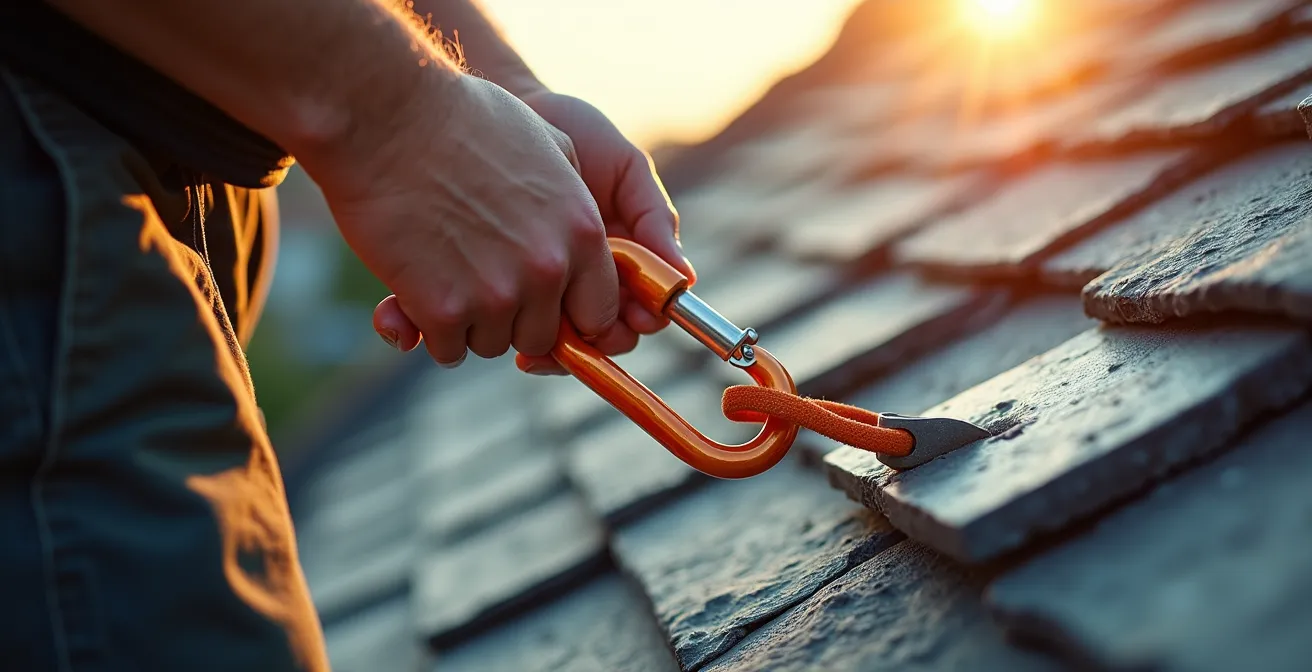
Steep pitch roofs present a paradox that haunts the construction industry. The very experience that makes roofers confident on challenging slopes can become their greatest liability. Every year, veterans with decades of experience fall from roofs they’ve navigated hundreds of times before, while the industry continues to rank among the most dangerous occupations in the United States.
The difference between professional roofing crews who consistently work steep pitches without incident and those who suffer preventable accidents isn’t just about equipment or training checklists. It lies in understanding the hidden biomechanical triggers of falls, reading invisible risk factors before setting foot on a roof, and building redundant systems that transform safety from a productivity constraint into a performance accelerator.
This article reveals the tacit knowledge that separates elite roofing professionals from those relying on surface-level safety protocols. You’ll discover why experience sometimes increases risk, how to conduct pre-climb assessments that prevent accidents before they happen, and the crew communication systems that coordinate teams in high-noise environments where a single miscommunication can prove fatal. The goal isn’t simply to avoid falls, but to adopt a strategic safety mindset that makes excellent work possible on the most challenging roofs.
Professional Steep Pitch Safety Essentials
- Experienced roofers face unique cognitive risks including overconfidence and automation bias that newer workers don’t encounter
- Surface friction coefficients can drop 50-85% when wet, with metal roofing becoming extremely hazardous even from body sweat
- Three-layer protection systems (prevention, arrest, consequence limitation) enable faster work by building cognitive confidence
- Crew communication protocols using visual signals and buddy-check systems coordinate teams when verbal communication fails
- Dynamic safety adaptation with defined stop-work triggers separates professional operations from reactive approaches
Why Steep Pitch Accidents Happen to Experienced Roofers
The statistics reveal an uncomfortable truth about roofing safety. Despite decades of improved equipment and mandatory training programs, the industry continues to experience 51.8 fatal injuries per 100,000 workers in 2023, maintaining its position among the three deadliest occupations in America. More troubling still is the demographic distribution of these fatalities—the majority aren’t rookies making beginner mistakes.
What researchers call the “expert paradox” explains this counterintuitive pattern. As roofers accumulate experience, their brains develop automated response patterns that allow them to work efficiently without conscious attention to every movement. This automation frees mental resources for complex problem-solving, but it simultaneously creates vulnerability. When familiar patterns encounter unfamiliar conditions—a slightly different moisture level, a temperature shift affecting material properties, or accumulated fatigue—the automated responses execute without the conscious risk assessment that kept the roofer safe during their learning phase.
The biomechanical reality of steep pitch work intensifies this cognitive trap. On slopes exceeding 6:12 pitch, the human center of gravity reaches critical thresholds where recovery from a slip becomes nearly impossible. Research in ergonomic engineering shows that at certain angles, gravitational forces overwhelm human reflex speeds. Once a worker begins to slide, the physics of acceleration mean they cannot regain stability before reaching a roof edge or obstruction.
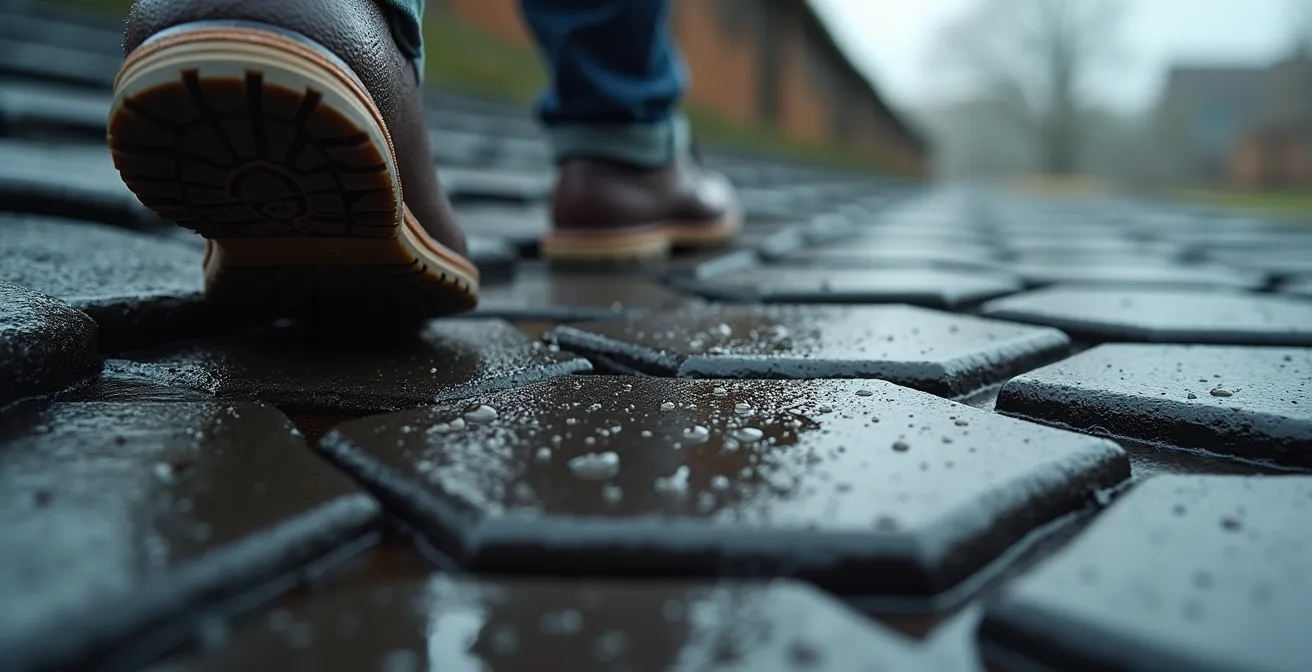
Surface conditions create invisible variations that compound these biomechanical vulnerabilities. Temperature fluctuations, residual humidity from overnight dew, and microscopic dust accumulation can alter friction coefficients by 40-60% within hours. An asphalt shingle roof that provided secure footing at 8 AM may become treacherous by 2 PM as surface temperatures climb, oils in the material soften, and accumulated sweat from safety harnesses creates localized slick zones.
The third critical factor involves decision-making fatigue that accumulates throughout the workday. Studies tracking construction workers performing elevated tasks document measurable degradation in risk judgment after six hours of continuous work at height. The mental resources required to constantly assess risk, maintain situational awareness, and override automated responses become depleted, even as physical fatigue hasn’t yet impaired movement capability. This creates a dangerous window where workers feel capable but their decision-making safeguards have quietly eroded.
Fatal Fall from Wet Steep Slope Conditions
A 50-year-old roofer with 20 years of experience died when he fell 18 feet from a house roof. The state investigator found that the victim’s rope grab lifeline was attached to a roof anchor, but he was not tied off to it when he slid on the wet roof underlayment and fell off the roof edge. This case, documented by OSHA investigations, illustrates how even experienced professionals can fall victim to momentary lapses in protocol adherence when familiarity breeds complacency.
The experience-level analysis reveals a striking pattern in accident demographics. While new workers face risks from inadequate training and improper equipment use, the data tells a different story for veterans. Experienced workers more frequently skip safety steps they perceive as redundant based on their successful history, creating what safety researchers term “calibrated overconfidence”—a statistically justified belief that their skill level provides adequate protection, right up until the moment it doesn’t.
| Factor | New Workers | Experienced Workers |
|---|---|---|
| Primary Risk | Lack of training | Overconfidence/complacency |
| Equipment Usage | Improper use | Skip safety steps |
| Fatal Fall Percentage | 30% | 70% among small employers |
Reading the Roof Before Setting Foot on It
Elite roofing crews distinguish themselves not by what they do on the roof, but by what they observe before ascending. While less experienced workers immediately begin setting up equipment after arriving at a job site, professional lead roofers conduct a systematic evaluation that transforms reactive improvisation into strategic risk management. This pre-climb assessment identifies hazard zones that aren’t evident from ground level and establishes a mental map of anchor points, movement paths, and fallback positions before committing to the ascent.
The five-factor assessment matrix that professionals employ evaluates pitch, weather, material composition, structural configuration, and timing in relation to each other rather than as isolated variables. A 9:12 pitch on dry asphalt shingles at 70°F might be manageable with standard equipment, but that same pitch on slate tiles with morning dew at 45°F represents an entirely different risk profile requiring specialized traction systems and extended setup time. Professional assessment recognizes these interactions rather than applying generic safety protocols.
Identifying what crews call “red zones” forms the core of strategic planning. Valleys concentrate water flow and retain moisture hours after the main roof surface has dried. Transitions between different pitch angles create points where center of gravity shifts require conscious attention to foot placement. Ridge areas near structural penetrations may offer solid anchor points but also present obstacles that disrupt fluid movement patterns. Shaded sections on north-facing slopes can harbor frost or condensation invisible from the ground, creating slip hazards in isolated patches rather than across the entire surface.
Pre-Climb Roof Assessment Protocol
- Measure roof pitch to determine if it exceeds 9:12 requiring special equipment
- Check for water stains on ceilings indicating potential weak spots in decking
- Identify ice dam formations at eaves that create slip hazards
- Look for visible roof sagging indicating structural compromise
- Verify weather conditions and avoid wet surfaces which become dangerously slippery
The mental mapping of anchor points before ascending separates strategic professionals from reactive workers. Lead roofers visualize primary attachment points at ridge lines, structural penetrations, and pre-installed permanent anchors, then identify secondary positions that provide redundancy if primary points become inaccessible due to work sequence or equipment conflicts. This cognitive preparation means that when a worker reaches a transition point requiring repositioning, they already know their next three anchor options rather than making decisions under physical and cognitive stress while maintaining balance on a steep slope.
What professionals term “three-points-of-contact planning” extends beyond the standard climbing rule to encompass movement across the roof surface. Before executing any transition that requires releasing a handhold or shifting weight, experienced roofers pre-visualize the sequence with guaranteed contact points at each micro-stage of the movement. This planning occurs during the ground assessment phase, not in real-time on the roof where divided attention and physical exertion compromise decision quality.
Edge proximity represents a critical assessment factor that demands special attention. Government safety reports indicate that 50% of fall deaths occur from roof edges, making perimeter work the highest-risk activity in steep pitch operations. Professional assessment identifies not just the obvious eave edges but also concealed drop-offs at dormers, skylights, and multi-level transitions where workers focused on their immediate task can back into a fall hazard they didn’t consciously register.
Metal roof materials typically are very slippery even when dry but become extremely slippery with moisture exposures due to environmental conditions and even body sweat.
– Carly Engels Johnston, 3M Personal Safety Division
Surface-specific friction analysis reveals variations that surprise even experienced roofers. The coefficient of friction—the measure of how much resistance a surface provides against sliding—isn’t a fixed property but a dynamic variable that changes with temperature, moisture, contamination, and even the specific tread pattern of work boots. Understanding these variations allows professionals to adjust their movement techniques, equipment selection, and work scheduling to match actual conditions rather than assumed surface properties.
| Surface Type | Dry Coefficient | Wet Coefficient | Risk Level |
|---|---|---|---|
| Asphalt Shingles | 0.90 | 0.45 | Moderate-High |
| Metal Roofing | 0.35 | 0.15 | Very High |
| Slate/Tile | 0.60 | 0.25 | High |
| Wet Debris Areas | N/A | 0.10 | Extreme |
Building Redundant Safety Systems That Don’t Slow You Down
The persistent myth that comprehensive safety systems reduce productivity continues to cost the roofing industry both lives and profit. In reality, the fastest crews on steep pitches consistently employ more safety systems than slower workers, not fewer. This apparent paradox resolves when you understand that redundant protection creates cognitive confidence that allows fluid, decisive movement, while inadequate safety forces constant hesitation that fragments workflow and extends project timelines.
Professional safety architecture follows a three-layer engineering principle adapted from aerospace and industrial applications. The primary layer prevents falls from initiating through physical barriers and traction enhancement. The secondary layer arrests falls in progress through harness and rope systems. The tertiary layer limits the consequences of system failures through controlled descent mechanisms and positioning that minimizes fall distances. Each layer operates independently, so failure of one component doesn’t compromise the entire system.
Primary prevention equipment creates physical constraints that make falls mechanically difficult to initiate. Properly installed toe boards along roof edges provide a tactile warning and physical barrier against backing off the roof while focused on overhead work. Roof brackets with handrails establish secure platforms that allow workers to maintain three points of contact even while handling materials. Chicken ladders and cleats create positive footholds that bypass surface friction variability entirely, transforming the roof into a series of secure steps rather than a continuous slope requiring constant balance attention.
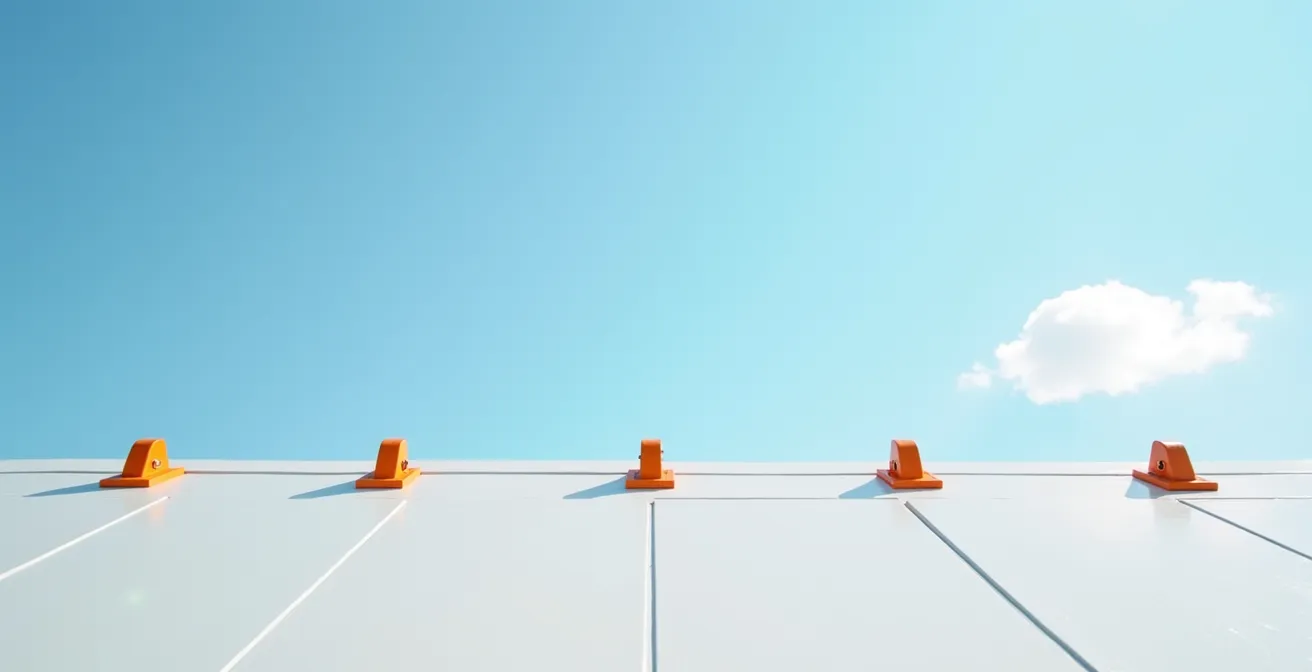
The secondary arrest layer activates if primary prevention fails, but only if configured to match the specific roof geometry and work sequence. Generic rope and harness setups often fail in practice because they don’t accommodate the reality of how roofers actually move across steep surfaces. Professional systems use properly positioned ridge anchors that provide 360-degree coverage, allowing workers to reposition without entering unprotected zones. Sliding rope grabs enable mobility while maintaining continuous connection, eliminating the dangerous practice of unhooking to move then reattaching at a new location.
A PFAS has 3 major components: The anchor catches you if you fall and must be attached to a structural member of your roof, not the shingles or sheathing.
– Mike Larsen, Larsen Roofing Owner
Performance data from professional crews demonstrates the productivity paradox of comprehensive safety systems. Time-motion studies tracking identical steep pitch tear-off and installation projects show that crews using complete three-layer systems finish 15-25% faster than minimally equipped teams. The mechanism isn’t mysterious—workers who trust their safety systems move decisively without the micro-hesitations that accumulate into significant time losses. They maintain focus on task execution rather than dividing attention between work and continuous risk assessment, resulting in both superior quality and enhanced speed.
Professional crews consistently report that specialized equipment becomes indispensable on extreme pitches. Advanced traction systems and positioning devices allow them to attempt roofs that would otherwise require alternative access methods like scaffolding or aerial lifts, expanding their project capabilities while maintaining safety standards. This approach mirrors best practices in professional home maintenance, where pre-emptive system design prevents emergencies rather than reacting to failures.
| Protection Level | Equipment | Function |
|---|---|---|
| Primary Prevention | Toe boards, roof brackets | Ergonomic handgrip rails with self-closing gates prevent fall initiation |
| Secondary Arrest | Harness and rope systems | Secure anchor points for tie-off when fall arrest required |
| Tertiary Protection | Safety nets, scaffolding | Prevent common types of roof accidents through consequence limitation |
The economic calculation that justifies comprehensive safety investment extends beyond accident prevention to encompass insurance premiums, project qualification, and workforce retention. Companies with documented safety systems access projects that exclude competitors with poor safety records. Workers increasingly choose employers based on safety culture, making comprehensive protection a recruitment and retention advantage in a tight labor market. The return on investment calculation shows that safety systems pay for themselves through reduced insurance costs alone, before accounting for productivity gains and expanded project opportunities.
The Crew Communication Protocols Nobody Documents
Individual safety equipment provides only partial protection on steep pitch projects because roofing is fundamentally a team activity where coordination failures create hazards that isolated workers cannot prevent. A ground crew member who doesn’t understand the roof worker’s current position might send up materials that strike the roofer or create swing loads on the rope system. Workers repositioning simultaneously without mutual awareness can create conflicting anchor point demands or unexpected load transfers. The communication systems that prevent these coordination failures remain largely undocumented in formal training, existing instead as tacit knowledge passed between experienced crew members.
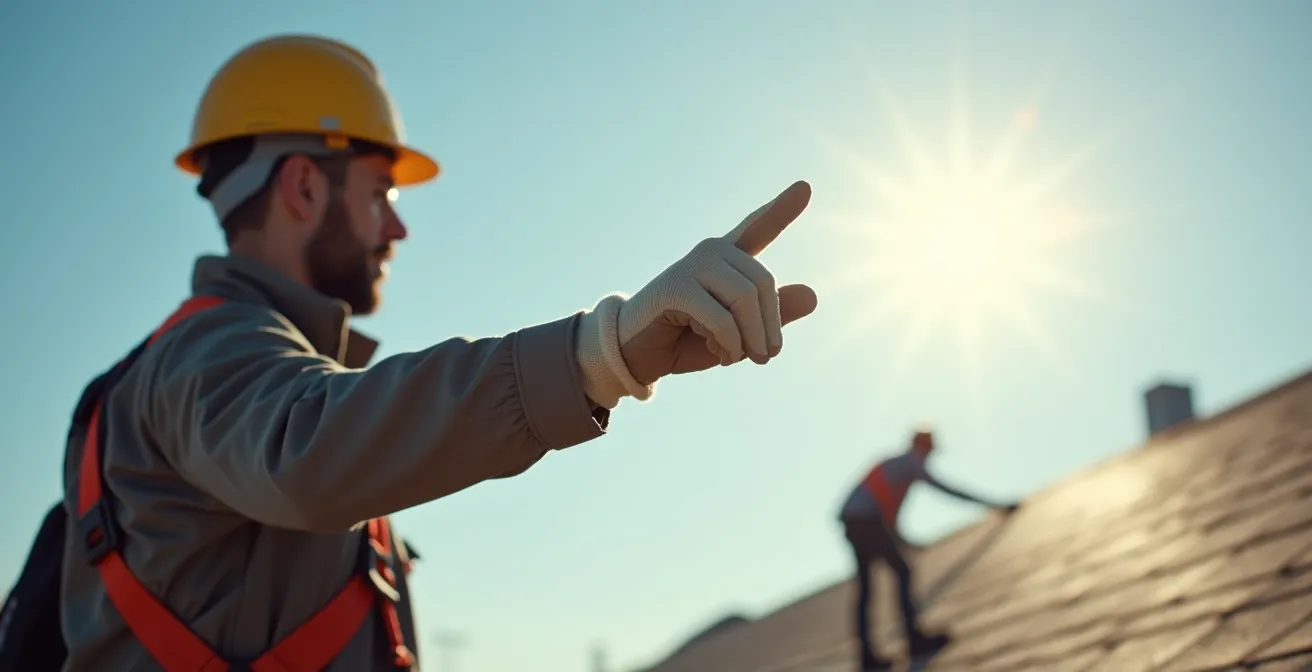
Visual communication protocols become essential on steep pitches where noise from pneumatic tools, material handling, and environmental factors makes verbal communication unreliable beyond a few feet. Professional crews develop standardized hand signals that convey specific meanings without ambiguity. A closed fist raised overhead signals “stop all activity immediately” rather than the vague “hold on” that could mean multiple things. Pointing to a location then making a lifting motion indicates “send materials to this position” with clear directional intent. Emergency signals use exaggerated movements that remain visible in peripheral vision, ensuring critical messages get through even when team members aren’t looking directly at each other.
The buddy-check system that elite crews employ before critical repositioning creates a human redundancy that catches errors before they become accidents. Before any worker unclips from an anchor point to move to a new position, their designated partner performs a visual verification of the new anchor’s security and confirms the movement path is clear of obstacles or hazards. This takes seconds but prevents the category of accidents where workers unknowingly attach to inadequate anchor points or move into positions where unseen hazards await.
Call-out protocols for high-risk actions create an auditory confirmation loop even in noisy environments. Before detaching and reattaching safety equipment, workers verbally announce their intention—”detaching from point A, moving to point B”—and wait for acknowledgment from their partner. This forced pause interrupts automatic behavior patterns and ensures that the worker consciously processes the action rather than executing it as an automated routine that might skip a critical step.
AI-Enhanced Crew Safety Communication Systems
Managing communication across dispersed crews presents unique challenges. As documented in a 2024 roofing industry analysis, it’s difficult to efficiently disseminate new information when crews are spread across a job site or 50 feet above ground level. Supervisors can use generative AI to write effective messages quickly, such as telling workers to start waterproofing because radar shows rain heading their way. They can also use AI to instantly translate messages so individual employees receive important notifications in their preferred language, eliminating dangerous communication gaps in multilingual crews.
The dedicated safety observer role that professional crews assign on pitches exceeding 8:12 represents a fundamental shift from viewing safety as an individual responsibility to recognizing it as a system property. This designated crew member doesn’t perform production work but instead maintains continuous situational awareness of the entire team, watching for fatigue indicators, environmental changes, and protocol deviations that individual workers might not notice while focused on their immediate tasks. The observer monitors weather radar for approaching conditions, tracks work duration to enforce break schedules before fatigue impairs judgment, and maintains communication with ground personnel to coordinate material flow and equipment needs.
Essential Crew Communication Equipment
- Noise-cancelling accessories help roofers working on loud jobsites, with earpieces and shoulder-mounted microphones allowing hands-free communication
- Two-way radios enable workers to call down to ground crew for tools and materials instead of climbing down repeatedly
- Commercial-grade radios offer excellent range for clear audio even when covering the vast areas of large warehouse roofs
In some situations, clear communication is vital for safety. Consider adding two-way radios to help workers coordinate with ground personnel or others on the roof.
– Roberson Roofing, Contractor Safety Guide
Technology integration in crew communication has evolved beyond simple walkie-talkies to encompass systems that actively prevent common coordination failures. Modern platforms allow supervisors to push weather alerts, safety reminders, and schedule updates directly to workers’ devices in real-time, ensuring critical information reaches everyone simultaneously. Just as comprehensive home security services employ layered communication protocols to coordinate responses, professional roofing crews build redundant channels that ensure messages get through even when primary systems fail.
Key Takeaways
- Understanding cognitive and biomechanical failure modes prevents accidents better than equipment alone can provide
- Pre-climb roof assessment transforms reactive improvisation into strategic risk management with planned anchor points
- Redundant safety systems enhance productivity by building cognitive confidence and enabling fluid workflow execution
- Crew communication protocols enable coordinated responses in high-noise, visually fragmented steep pitch environments
- Dynamic safety adaptation to changing conditions separates professional crews from reactive amateur approaches
Adapting Your Safety Strategy to Changing Conditions Mid-Project
The pre-climb assessment establishes initial safety parameters, but professional steep pitch work requires continuous monitoring and dynamic adjustment as conditions evolve throughout the workday. Weather patterns shift, surface temperatures change, crew fatigue accumulates, and unforeseen structural issues emerge. Elite crews distinguish themselves not by perfect initial planning but by systematic reassessment protocols that detect deteriorating conditions before they cause accidents.
Technology has transformed the weather monitoring capabilities available to roofing crews. Real-time weather data and radar integration reduce accident risk by allowing contractors to proactively reschedule work during hazardous conditions rather than reacting to rain already falling or wind gusts that have already created dangerous situations. Modern platforms provide minute-by-minute precipitation forecasts, wind speed projections, and lightning detection that enable crews to secure the work site and descend before conditions deteriorate to dangerous thresholds.
The concept of “stop-work triggers” creates objective decision points that remove subjective judgment from critical safety calls. Rather than relying on individual workers to assess whether conditions remain safe—a judgment that cognitive biases and production pressure can distort—professional crews establish non-negotiable thresholds that mandate work stoppage. These triggers are specific, measurable, and communicated to all team members before ascending to the roof, eliminating arguments about whether conditions truly warrant stopping work.
| Condition | Threshold | Action Required |
|---|---|---|
| Wind Speed | 20+ mph sustained | Mandatory descent and work stoppage |
| Surface Temperature | >150°F or <40°F | Mandatory work stoppage until temperatures moderate |
| Precipitation | Any active rain or snow | Immediate work cessation on steep pitches |
| Ice Formation | Visible frost or ice | No work until surface cleared and dried |
Graceful degradation protocols define how crews transition from optimal production mode to reduced-capacity safe mode to complete work stoppage in a structured manner rather than binary on-off decision-making. As conditions approach stop-work thresholds, the crew first implements enhanced safety measures—additional anchor points, reduced work pace, increased communication frequency—while continuing productive work. If conditions continue deteriorating, they transition to securing the work site and preparing for descent before reaching the absolute stop threshold, preventing the dangerous scenario where crews scramble to secure materials and equipment in actively hazardous conditions.
The micro-indicators that experienced crews monitor extend beyond obvious weather changes to include subtle signs of deteriorating safety margins. Surface friction changes from accumulated dust or temperature-driven material property shifts become apparent through increased foot slippage or reduced traction feedback. Team fatigue manifests as longer reaction times, decreased communication, and postural changes that indicate reduced stability margins. Equipment wear shows in frayed ropes, loosened connections, or deformed components that haven’t yet failed but indicate approaching service life limits.
Modern communication tools, like walkie-talkies, mobile apps, and radios, allow for seamless communication between team members on a job site. In case of emergency, roofing contractors can quickly coordinate, providing prompt response.
– JBC Roofing Co., Safety Innovation Report
The two-hour reassessment protocol that top-performing crews implement creates structured checkpoints that prevent the gradual drift into unsafe conditions that occurs when teams become absorbed in production work. Every two hours, the designated safety observer calls a brief pause during which the crew systematically evaluates five parameters: current weather versus forecast, equipment condition and positioning, individual and collective fatigue levels, work zone hazards that may have developed, and any scope changes that alter the initial risk assessment. This five-minute investment prevents the scenario where conditions silently deteriorate over hours until a threshold is crossed without conscious awareness.
Adaptive safety requires empowering every crew member to call a stop without fear of negative consequences—a cultural shift that separates truly professional operations from those that merely comply with regulations. When the newest apprentice has both the authority and the psychological safety to halt work based on a perceived hazard, the crew gains a distributed sensing network that dramatically outperforms hierarchical systems where only supervisors can make safety calls. Professional crews explicitly state during pre-job briefings that any team member can stop work, no questions asked, no explanations required until everyone is in a safe position.
Frequently Asked Questions on Roofing Safety
Why do experienced roofers still have high accident rates despite their expertise?
The expert paradox explains this phenomenon. As roofers gain experience, their brains develop automated response patterns that allow efficient work without conscious attention to every movement. However, this automation creates vulnerability when familiar patterns encounter unfamiliar conditions like subtle moisture changes or accumulated fatigue. Additionally, experienced workers more frequently skip safety steps they perceive as redundant based on their successful history, creating what researchers term “calibrated overconfidence” that proves accurate until the moment it fails catastrophically.
What makes a roof surface dangerously slippery beyond just rain or snow?
Friction coefficients change dramatically with factors beyond obvious precipitation. Temperature fluctuations cause material property changes, with asphalt shingles becoming slick above 150°F and rigid below 40°F. Residual humidity from overnight dew, microscopic dust accumulation, and even body sweat from safety harnesses create localized slick zones. Metal roofing presents extreme challenges, with wet coefficients dropping to 0.15 compared to dry surfaces at 0.35, making them treacherous even from environmental moisture or perspiration. Surface contamination from organic debris can reduce friction to dangerous levels of 0.10 in isolated patches.
When should crews immediately stop work on steep roofs?
Professional crews establish non-negotiable stop-work triggers that remove subjective judgment from safety decisions. Work must cease immediately when sustained wind speeds reach 20 mph or above, when surface temperatures exceed 150°F or drop below 40°F, when any active precipitation begins, or when visible frost or ice forms on surfaces. Additionally, workers must familiarize themselves with and adhere to current OSHA regulations, which mandate that the presence of walkboards or scaffolding does not eliminate the need for safety ropes and harnesses on steep pitches.
How do professionals handle sudden weather changes during active steep pitch work?
Elite crews implement graceful degradation protocols rather than binary stop-work decisions. As conditions approach thresholds, they first enhance safety measures by adding anchor points, reducing work pace, and increasing communication frequency while continuing productive work. If deterioration continues, they transition to securing the work site and preparing for descent before reaching absolute stop thresholds. Modern weather monitoring technology provides minute-by-minute forecasts that enable proactive responses, while safety ropes, harnesses, and scaffolding remain required equipment regardless of initial conditions, ensuring crews can respond safely when weather shifts unexpectedly.