
Ottawa homeowners planning kitchen overhauls or basement conversions routinely face the same invisible trap: the moment they hire three separate contractors for plumbing, electrical, and cabinetry, they’ve activated a coordination minefield frequently driving projects 15 to 25 percent over initial estimates according to industry observations through scheduling conflicts and rework that nobody anticipated.
Single-point management—where one general contractor orchestrates all trades under a unified contract—eliminates these friction points by centralizing accountability and sequencing. Yet most renovation guides gloss over the precise conditions under which this approach becomes cost-protective versus merely convenient. The deciding factors cluster around trade complexity, timeline rigidity, and the homeowner’s capacity to absorb coordination failures.
The question facing anyone about to demolish walls in Barrhaven or Centretown isn’t whether coordination matters—it’s whether your project’s specific variables make fragmented contractor management a financial gamble you can’t afford.
Ottawa’s residential renovation market faces unique pressures in early 2026. Tariff-related uncertainty and delayed construction plans led many homeowners to postpone major expenditures in Q1 2025, tightening planning windows for those proceeding with kitchen overhauls and basement conversions. The compressed timelines amplify coordination risks when multiple independent contractors compete for limited site access and inspection slots.
This analysis examines the structural mechanics behind cost protection, comparing three contractor management scenarios against Ottawa project data to identify when unified oversight shifts from optional convenience to financial necessity. The threshold that determines whether fragmented coordination threatens your budget clusters around factors you can assess before signing any contract.
Your budget protection essentials in 60 seconds:
- Multi-contractor coordination failures add $2,500 to $5,000 CAD in rework and delay costs on typical Ottawa kitchen projects through sequencing errors and duplicate site visits, contributing to the 15-25% budget variance observed in fragmented project management scenarios
- Ontario’s Consumer Protection Act caps contractor charges at 10% above estimates without written approval, but fragmented management creates scope gaps this rule can’t close
- Single-point contracts shift liability and scheduling conflicts to one accountable party, eliminating the blame-shifting that stalls projects when the electrician and plumber can’t agree on wall access
- Red flag threshold: projects requiring three or more specialized trades, fixed completion deadlines, or work on pre-1980 homes with unknown infrastructure need unified oversight to prevent budget hemorrhaging
Why renovation budgets spiral out of control
Residential renovation costs in Ontario have followed a relentless upward trajectory, with the Q1 2025 Residential Renovation Price Index published by Statistics Canada recording a 0.3 percent quarterly increase—the smallest gain since Q2 2020, yet still climbing. Ontario homeowners saw a rare dip of 0.3 percent in provincial costs during the same period, offering temporary relief that masks a deeper structural problem: coordination breakdowns generate the invisible majority of cost overruns that blindside homeowners.
10%
Maximum a contractor can charge above estimate without written approval under Ontario law
That 10 percent statutory cap, enshrined in Ontario’s Consumer Protection Act provisions on renovation cost overruns, offers meaningful protection against contractor price inflation on signed estimates. The regulation collapses, however, when applied to multi-contractor scenarios where no single estimate governs the entire scope. An Ottawa couple planning a kitchen renovation in their 1978 home engaged a plumber, electrician, and cabinetry installer through separate quotes totalling $34,800 CAD. The plumber discovered the existing drain configuration wouldn’t support the new island sink without rerouting—a change requiring cabinet base modifications the installer hadn’t quoted. The electrician couldn’t access wall cavities until plumbing rework finished, forcing a three-week delay. Cabinet installation revealed the modified plumbing had shifted measurements beyond original specs, necessitating custom panel fabrication at $1,800 CAD. The framing crew had enclosed walls before the electrical inspector could verify code compliance, triggering a stop-work order. Demolishing finished drywall to expose wiring for inspection, then re-closing and refinishing, added $2,800 CAD. Equipment rental stretched from six weeks to nine at $1,200 CAD additional cost. Final tally: $39,000 CAD, a $4,200 CAD overrun driven entirely by coordination failures no single contractor controlled.
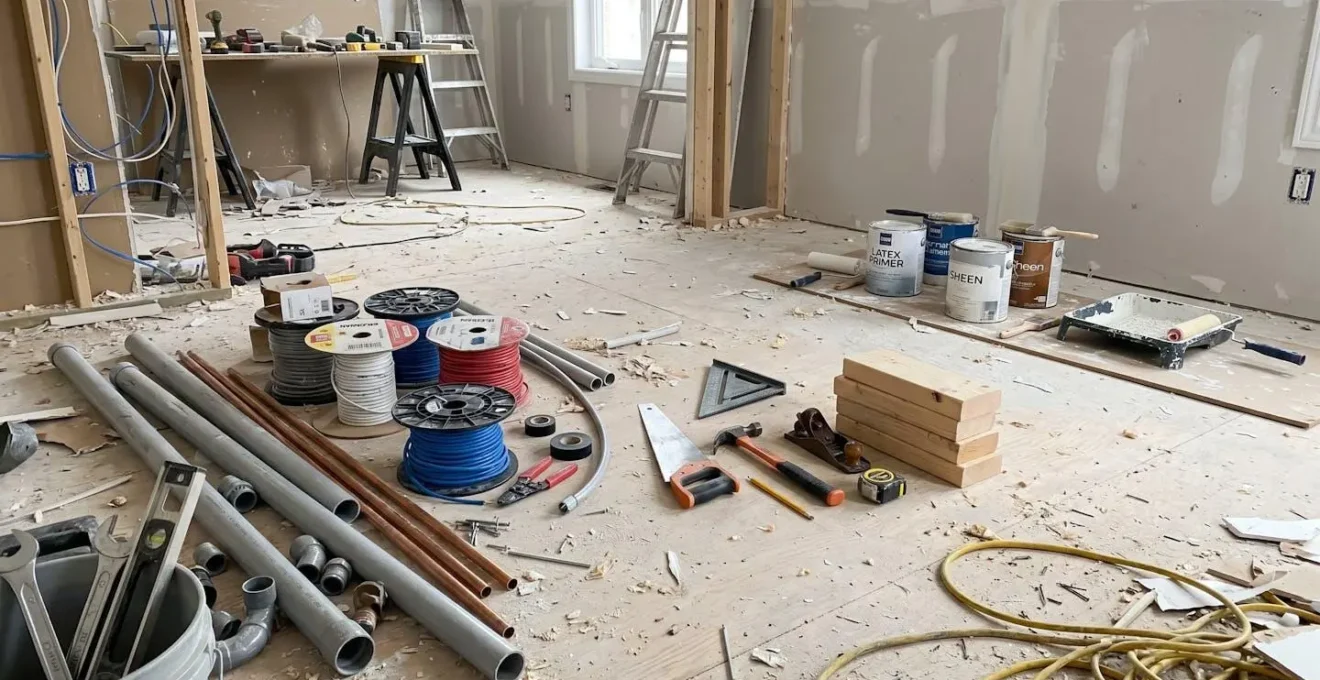
Three root causes drive this pattern. Trade sequencing errors occur when specialists arrive out of optimal order, forcing rework that compounds delays. Scope creep through contract gaps exploits the spaces between separate agreements where responsibilities blur. Change order proliferation accelerates in fragmented setups because no single party has authority to assess modification impact across all trades, turning minor adjustments into cascading recalculations.
How a unified contractor prevents budget blowouts
The protective mechanisms embedded in single-point management systematically close the gaps where multi-contractor projects bleed money. Pricing transparency begins at contract signing: a general contractor bids the entire scope as a unified package, absorbing internal coordination costs into a single fixed price or clearly defined cost-plus structure. General contractors typically add markup ranging from 15 to 20 percent over direct subcontractor costs, a premium that covers coordination services, liability consolidation, and project oversight.

Trade sequencing precision becomes feasible when one entity controls the critical path. The general contractor schedules plumbing rough-in, then electrical, then HVAC, with inspection windows built into the timeline. Consolidated accountability means warranty claims, defect corrections, and scope disputes route through one responsible party who can’t deflect blame to absent subcontractors. Bulk purchasing power allows established contractors to source materials at trade discounts unavailable to homeowners buying retail. Change order discipline tightens under unified management because the contractor assesses modification costs against the entire project scope in real time.
Ottawa-based full-service operations like trehanecarpentry.com demonstrate this coordinated model through unified trade management and transparent budget oversight, a structure that has governed residential renovation delivery for over two decades in the region. This operational maturity translates directly into cost predictability: projects managed under unified contracts experience fewer change orders and schedule extensions because a single entity controls the critical path from permit application through final inspection. The operational advantage isn’t just administrative convenience—it’s the elimination of the coordination tax that multi-contractor setups impose through communication overhead, schedule conflicts, and responsibility ambiguity.
Single general contractor managing all trades: The homeowner signs one contract covering all work. The contractor employs or subcontracts all trades, pays them directly, and coordinates their sequencing. Budget protection flows from contractual unity: the 10 percent cap under Ontario law applies to the entire scope, and any cost increase requires written change authorization. Timeline predictability improves because the contractor bears financial risk for delays.
Homeowner coordinating separate contractors: The homeowner hires individual specialists through separate quotes and manages scheduling, payments, and conflict resolution personally. Each contractor optimizes for their own profit and timeline, creating friction points where trades compete for site access or blame each other for delays. Budget exposure multiplies because each trade’s quote includes built-in contingencies for unknowns they can’t control.
Hybrid approach with project manager: An independent project manager coordinates separate contractors on the homeowner’s behalf without performing actual construction. The PM charges a management fee—typically 10 to 15 percent of total project cost—to handle scheduling, inspections, and dispute mediation. The budget protection remains partial: the PM can flag coordination issues but lacks contractual authority to compel cooperation between independent contractors.
| Management Model | Direct Cost Premium | Homeowner Time Required | Budget Predictability | Liability When Issues Arise | Warranty Coverage |
|---|---|---|---|---|---|
| Single General Contractor | GC markup 15-20% (but absorbs coordination costs) | 5-10 hours total (design approvals, progress checks) | Highest (fixed price or capped cost-plus) | Single responsible party under one contract | Unified warranty |
| Homeowner Multi-Contractor DIY | No markup (but pays retail material pricing + compounded contingencies) | 15-25 hours weekly | Lowest (gaps between contracts create exposure) | Fragmented across multiple contractors (blame-shifting common) | Patchwork warranties (each trade covers own work only) |
| Hybrid Project Manager | PM fee 10-15% on top of individual trade costs | 8-12 hours (reduced coordination, final approvals) | Medium (PM flags issues but can’t compel cooperation) | PM coordinates but contractors remain independent (disputes still multi-party) | Individual trade warranties (PM may facilitate claims) |
The table reveals a counterintuitive insight frequently missed in cost comparisons: the homeowner DIY model’s apparent savings from eliminating GC markup disappear when you account for coordination time valued at professional rates. A homeowner earning $40 CAD per hour who invests 20 hours weekly over an 8-week kitchen project contributes $6,400 CAD in opportunity cost—erasing any markup savings and often exceeding the cost difference between models.
Choosing between these three models requires assessing your project’s specific risk profile rather than defaulting to the lowest sticker price. Three diagnostic questions clarify which approach protects your budget.
- How many specialized trades does your renovation require?
Three or more trades (plumbing, electrical, HVAC, cabinetry) justify single-point management. Two or fewer trades with flexible timeline tolerate DIY coordination.
- Do you have a fixed, non-negotiable completion deadline?
Fixed deadlines (home sale, family event, lease expiration) require single-point contracts with completion penalties that transfer delay risk to the contractor. Flexible timelines make DIY coordination viable if you can absorb unexpected gaps.
- Have you managed a multi-trade construction project before?
First-time renovators lack the pattern recognition to spot sequencing errors or contractual gaps until problems surface mid-project. If this is your first major renovation, the learning curve carries budget cost that single-point management avoids.
Red flags that signal you need coordinated management
Six warning signs consistently predict scenarios where fragmented contractor management shifts from economical to financially reckless. Projects requiring municipal permits across multiple disciplines create cascading delays when your scope triggers separate inspections for structural framing, electrical systems, and plumbing rough-ins.
- Your renovation involves three or more specialized trades requiring sequential coordination (plumbing before tile, electrical before drywall, HVAC before insulation)
- You’re working on a home built before 1980 with unknown infrastructure conditions (outdated wiring, cast-iron plumbing, asbestos insulation potential)
- Your timeline includes a hard, immovable completion deadline (home sale closing, family arrival, lease expiration)
- Your budget has zero contingency buffer and cannot absorb unexpected coordination failures or rework costs
- You work full-time or travel frequently and cannot dedicate 15+ hours weekly to contractor calls, site visits, and problem-solving
- This is your first residential renovation and you lack prior experience reading construction drawings, interpreting building codes, or managing trade disputes
Tight budget constraints with no contingency reserve represent a critical marker. According to CHBA’s national homeowner guide to renovation contracts and project accountability, professional contractors recognize that detailed specifications must be attached to contracts to prevent scope drift and the cost overruns it generates. That discipline becomes nearly impossible to maintain across three or four independent contractors each interpreting specifications differently.
Pre-1980 housing stock carries hidden infrastructure risks—knob-and-tube wiring, galvanized plumbing, asbestos—that demand adaptive problem-solving when discovered mid-project. A general contractor with standing relationships across trades can mobilize remediation crews and adjust the timeline within 48 hours. Full-time employment that limits availability for daytime site visits converts minor coordination hiccups into week-long stalls.
Proper site safety coordination across trades—from working safely on steep pitches during roofing phases to electrical work sequencing—requires unified oversight often missing in fragmented contractor setups. A plumber cutting floor joists to route supply lines without consulting the framing contractor can compromise structural integrity that manifests only when the electrician later attempts to anchor a heavy panel box to weakened framing. These cross-trade safety failures emerge from communication gaps that single-point management eliminates through daily coordination meetings and unified site supervision. The liability exposure when one trade’s work endangers another’s crew becomes a homeowner problem in DIY coordination scenarios, whereas single-point contracts consolidate that responsibility under the general contractor’s insurance umbrella and safety protocols.
When you likely don’t need single-point management: Single-trade or simple two-trade projects with flexible timelines and homeowners who possess construction experience may tolerate multi-contractor DIY approaches. The threshold shifts when trade count rises above two, unknowns multiply, or your capacity to absorb delays evaporates.
What to verify before hiring a full-service contractor
A Kanata homeowner discovered the cost of inadequate vetting when their chosen general contractor’s liability insurance lapsed mid-project. A plumbing error flooded the basement, causing $18,000 CAD in damage. The contractor’s expired policy left the homeowner pursuing recovery through small claims court while living in a construction zone for eight additional months. The scenario underscores the first non-negotiable verification: current, adequate insurance coverage confirmed through certificates of insurance issued directly by the carrier.
Reputable general contractors carry substantial liability insurance to protect homeowners. Request certificates showing at least $2 million general liability plus Workplace Safety and Insurance Board (WSIB) clearance confirming the contractor maintains coverage for any employees or subcontractors working on-site. Call the insurance company directly using contact information you look up independently to verify the policy remains active and covers residential renovation work specifically.
Licensing and local references form the second verification layer. Verify the contractor holds current Ottawa business registration, check their Better Business Bureau standing, and request three references from projects completed within the past 18 months in Ottawa neighbourhoods similar to yours.
- Obtain and independently verify current certificates of insurance (minimum $2 million liability) and WSIB clearance by calling carriers directly
- Confirm City of Ottawa business licence registration and check Better Business Bureau accreditation status and complaint history
- Contact three recent client references about budget control and dispute resolution
- Review the written contract for detailed scope specifications (brands, models, colours), payment schedule tied to completion milestones, and explicit change order approval process
- Verify warranty terms cover both labour and materials for minimum one year post-completion, with clear claims process documented in writing
- Confirm the contractor will obtain all required building permits and schedule mandatory inspections, with permit numbers provided to you before work commences
Contract detail and change order protocols deserve obsessive attention. Professional contractors run businesses and recognize that a written contract is an indispensable part of good business practices, as industry associations consistently emphasize. Any contract over $50 CAD must be written under Ontario law. Payment schedules should tie disbursements to verifiable completion milestones, not arbitrary calendar dates. The change order section must specify that any scope modification requires written approval with updated cost and timeline before work proceeds.
Standard deposits range from 5 to 15 percent of contract value according to industry norms, with higher amounts justified only when custom products require advance ordering. Reject contractors demanding 30 or 50 percent upfront—that structure signals cash flow problems. Verify the contract includes Ontario’s statutory 10 percent holdback provision, which protects you by retaining final payment until substantial completion and lien period expiration.
Warranty coverage and claims processes vary across contractors. Insist on written warranties covering both labour and materials for a minimum one year post-completion, with clear procedures for submitting defect claims.
Do single-point contractors cost more than hiring trades separately?
General contractors typically add 15 to 20 percent markup over direct subcontractor costs, but that premium buys coordination services, bulk material discounts, liability consolidation, and timeline guarantees that DIY management can’t replicate. When you factor in the hidden costs of multi-contractor coordination—your time valued at professional rates, duplicate contingency buffers each trade embeds, and rework from sequencing errors—the total cost of ownership often favours single-point contracts despite higher sticker prices.
What should a renovation contract include to protect my budget?
Essential elements include detailed material specifications (brands, models, colours), a payment schedule tied to verifiable completion milestones rather than dates, explicit change order approval requirements with cost and timeline updates in writing, warranty terms covering labour and materials, permit responsibility assignment, and the Ontario statutory 10 percent holdback provision. Avoid contracts with vague descriptions like « builder-grade fixtures » or « as needed » pricing.
Can I make changes to the project scope after signing a contract?
Yes, through formal change orders that document scope modifications, associated costs, and timeline impacts. Under Ontario law, contractors cannot charge more than 10 percent above the original estimate without your written approval of contract changes. Reputable contractors present change order requests in writing with updated pricing and completion dates before proceeding, giving you clear decision points rather than surprise bills at project end.
What recourse do I have if the contractor fails to complete work properly?
Ontario’s 10 percent statutory holdback gives you leverage—retain that final payment until deficiencies are corrected and the lien period expires. Document all issues in writing with photos and dates, then invoke the warranty claims process outlined in your contract. If the contractor remains unresponsive, you can file complaints with the Better Business Bureau and pursue resolution through Ontario’s Licence Appeal Tribunal or small claims court. Single-point contracts simplify this process by consolidating all claims under one agreement rather than chasing multiple subcontractors.
The verification discipline pays dividends in risk reduction. Once your renovation wraps up, final details like professional cleaning for moving checklist ensure a smooth handover—a step often overlooked in rushed, poorly coordinated projects where contractors exit before completion cleanup standards meet homeowner expectations. The contractors who document every verification step, produce insurance certificates without prompting, and reference detailed specification protocols during initial consultations signal the operational maturity that protects your budget when unforeseen complications surface mid-project.